

The ethanol blend rate in U.S. gasoline now stands at its highest in history, driven in part by the conflict in Iran improving the cost advantage for the renewable fuel, according to the latest data from the Energy Information Administration analyzed by Renewable Fuels Association Chief Economist Scott Richman.
The average ethanol content of gasoline sold in the U.S. surged to a record 11.29% in May, as petroleum prices hit their highest monthly averages of the Iran war, and for the 12 months through May, the ethanol blend rate in gasoline rose to 10.57%, the highest annual share ever.
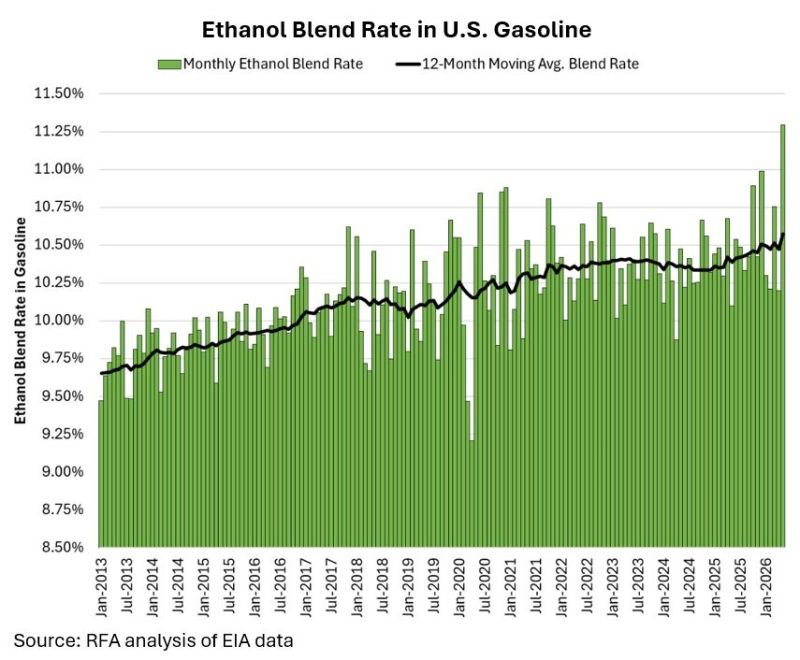
The increase was spurred by compelling ethanol blending economics. Ethanol was priced at a discount to gasoline blendstock of nearly $1.50 per gallon on average in May, based on futures contracts. Additionally, the price of renewable identification numbers (RINs), credits which are used for compliance with the Renewable Fuel Standard, strengthened this spring and surpassed the price of ethanol for the first time ever. That is, since each gallon of denatured ethanol is sold with a RIN attached, the net price of the physical ethanol has effectively been negative.
The vast majority of gasoline sold in the U.S. contains 10% ethanol, a blend known as E10. During May, the ethanol content in E10 provided a fuel cost savings of $0.14 per gallon of finished gasoline, along with $0.21 of RIN value to the blender. In gasoline containing 15% ethanol, known as E15, the fuel cost savings was $0.21 per gallon, and the RIN value was $0.31.
The presence of ethanol has mitigated the increase in gasoline prices for all drivers. Those who have access to E15 in their areas have saved even more, as pump prices of E15 have typically been $0.20 to $0.40 per gallon lower than regular unleaded gasoline. It is clear from the increase in the national average blend rate to 11.29% that blenders, retailers, and consumers have responded to these compelling economics.