

 Over 20 agricultural and biofuels groups sent a letter this week to administration officials urging them to establish reasonable guidelines that will allow farmers to benefit from the 45Z clean fuel production tax credit, which is designed to facilitate the sale of ethanol and other biofuels in the aviation sector.
The letter was sent to officials at Treasury, the Department of Agriculture, Department of Energy and the White House and signed by a range of groups, including the National Corn Growers Association, National Sorghum Producers Association, Renewable Fuels Association, National Oil Seed Processors Association, and Clean Fuels Alliance of America.
Ag groups are urging the agencies to provide a seat at the table for farmers and recognize their long-standing use of conservation practices, such as cover crops and no-till or strip-till.
“Farmers often must make significant capital investments in equipment, absorb variable costs such as cover crop seed, and undertake significant management changes,” the letter said. “Clear 45Z guidance is critical for farmers and their lenders to plan with confidence. Without regulatory certainty on the inclusion of on-farm practices, those incentives will not materialize at the scale necessary to drive participation.”
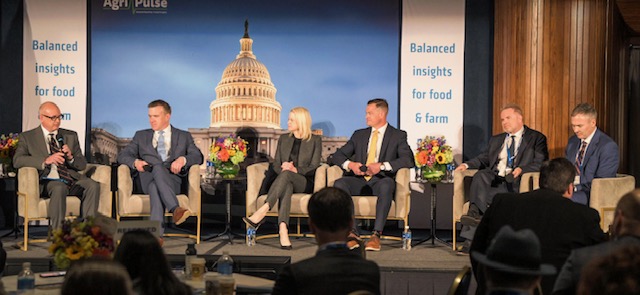
Agri-Pulse Ag and Food Summit panel on renewable fuels
“We are eagerly awaiting guidance from USDA for that tax credit around the crediting of these agricultural practices that served to achieve that end,” said Tom Michaels with United Airlines during the first panel which focused on mapping out a comprehensive U.S. renewable fuels strategy. “We made about 1% of our fuel from SAF this past year, which is a huge increase over where we were just a few years ago. But we really do see that demand exploding. And that’s really exciting, I think, for the ag sector, because while currently most of that fuel is derived from waste products like fats, oils, and greases, there’s a hard limit on how much of that is out there, and we’re going to need crop-based feedstocks to feed that demand.”
The second panel on new uses to drive value-added demand also touched on the tax credit because of its significance in opening both aviation and maritime markets for crop-derived fuels. “With 45Z, as they were talking about in the earlier panel, we’re invested, we’re trying to be ready for when we get that green light,” said Kansas farmer Amy France, National Sorghum Producers chair. “We’ve done things different the last growing season. We’ve taken pictures. We’ve been even better with our data. And now we’re sitting here, now what do we do? And will we actually get money back in my farmer pocket?”
Listen to the panels:
Mapping out a comprehensive U.S. renewable fuels strategy
Ben Kruger, Roeslein Renewables
Louis Sola, Thorn Run Partners
Anne Steckel, Ardent Strategies
Tom Michels, United Airlines
Devin Mogler, National Oilseed Processors Association
Agri-Pulse Summit panel one 43:37
New uses to drive value-added demand
Gregory Jaffe, Jaffe Policy Consulting LLC
Sean Arians, National Corn Growers Association
Amy France, National Sorghum Producers
Lindsay Fitzgerald, Gevo
Agri-Pulse Summit panel two 40:25