
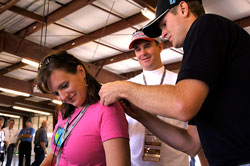
 What could be a better souvenir for the EPIC 2007 Peak Antifreeze Indy 300 experience than an autograph from Team Ethanol Driver Ryan Hunter-Reay? Well, perhaps a picture and a souvenir would be better. Well, members of the Ethanol Promotion and Information Council and sweepstakes winners Jerry and Bud Carter got both. Ryan was a true sport and was eager to accommodate the members, signing autograph cards, tickets, photos and shirts. Be sure to access the group photos with Ryan by clicking the link to the Flickr photo album below.

Break It Down
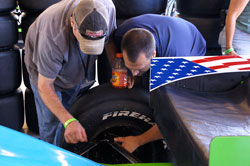 Members of the Ethanol Promotion and Information Council and the Race to Go Green Sweepstakes winners, Jerry and Bud Carter toured the garage that houses the Team Ethanol IndyCar this morning. Mechanics explained the complex construction of theses IndyCars from its electronic capabilities, $30,000 detachable steering wheel, design, construction and maintenance, down to the very fuel that IndyCar engines burn: a 98% blend of ethanol fuel.
Race Day Frenzy
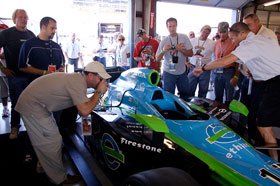 It has already been a busy day here at the Chicagoland race track in Joliet, IL. The Ethanol Promotion and Information Council has a lot going on for its members and for its Race to Go Green Sweepstakes Jerry and Bud Carter winners at the final IndyCar Series Race for the 2007 season.
  I’ll be posting coverage on the garage tour and the autograph session with with Ryan Hunter-Reay, along with interviews from several EPIC members, EPIC Executive Director Tom Slunecka, Team Ethanol Driver Ryan Hunter-Reay and Rahal-Letterman Racing’s very own Bobby Rahal. But first, I need to run down to the track and grab some shots of Jerry and Bud during their “Hot Lap,” a trip around the track in an official pace car as part of the VIP treatment these two are receiving as sweepstakes winners. I’ll catch you up to speed with everything EPIC has going on when I get back.
Firehawk Fun
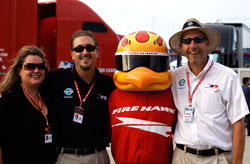 Ethanol Promotion and Information Council leadership are enjoying the perfect race weather with today’s high in the tepid 80s here at the Chicagoland track. Robyn Slunecka, Executive Director Tom Slunecka, and Director of Industry Relations Steve Rust grabbed Firehawk for a quick photo op.
Win Single-Seat Driving Experience
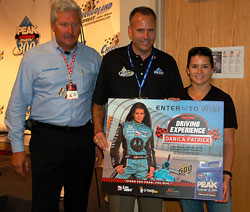 It will be the first time ever that fans can win a Indy single-seat driving experience during the month of May – the month of the Indianapolis 500. Peak Antifreeze and GoDaddy.com are sponsoring the 2008 IndyCar Series Driving Experience Sweepstakes. The sweepstakes will offer fifteen fans a VIP experience during the Pole Qualifying Weekend and the 2008 Indianapolis 500. Danica Patrick will offer the winners race training and tips before they drive a single-seat a retired IndyCar around the 2 and half mile track.
Listen to Danica commenting on the sweepstakes here:
[audio:http://www.zimmcomm.biz/audio/Patrick_Danica_Peak.mp3]Dario Franchitti Wins Peak Antifreeze 300 Pole
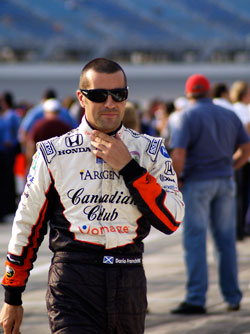 The man first in the running for the 2007 IndyCar Series Championship wins the pole position for the final race of the season. Canadian Club Driver Dario Franchitti secured the pole with a qualifying speed of 214.646 mph and a qualifying time of 25.4931 seconds. Sam Hornish Jr. snatched the second pole position with a qualifying time of 25.5115 seconds and Helio Castroneves grabbed the outside pole with a qualifying time of 25.5248 seconds.
“It’s nice to start up front, have a clear track… we’ve got to work hard on keeping the car out there tomorrow,” Dario said.
Team Ethanol Qualifies for Peak Antifreeze Indy 300
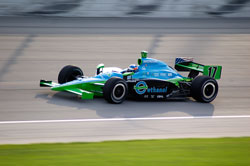 I guess teammates Scott Sharp and Ryan Hunter-Reay like to stick together. Both qualified for the Peak Antifreeze Indy 300 race on Sunday at 3:00 p.m. Scott qualified for the 11th position and Ryan slid in right behind him for the 12th position. Ryan’s qualifying time came in at 25.7566 with a top speed of 212.450 mph.
“The time just wasn’t in the car today,” Ryan commented about his position. “We’ll have to work on the car and make it faster for tomorrow. I know we have a car that can run in the top half of the field. We’ll just keep it up there and see what we can get.”
White’s the Pits, Red’s the Best
 My data for the second practice run came in a bit late because just after the run, Chicagoland Head Photographer Steve Snoddy escorted me to the drop gates reserved for photographers with the red vests for the start of the ARCA race. Only 25 photographers receive the honor of sporting a red vest throughout the weekend. Previously, I had white vest access, aka strictly pit access. The drop gates are cut outs along the fence that encircles the track, which explains why management is so restrictive with who can shoot at these prime locations. Needless to say, Steve is an accessible Chicagoland hot shot who is eager to share his love of racing and his experience.
While I was out at the drop gates, Honda President of Performance Development Robert Clarke commented on the performance of ethanol fuel during the 2007 Indy season. Robert explained that the use of ethanol ultimately led to the series’ decision to eliminate the IndyCar lean switch, a switch that previously allowed the driver to tell the engine to lean the fuel mixture to conserve fuel. Robert also announced that the Indy Racing League will continue to run on 100% ethanol fuel next year. He said the next step is for the league to work on further improving ethanol fuel consumption.
Getting the Grip
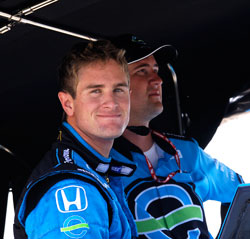 Team Ethanol Driver Ryan Hunter-Reay cut out of practice session two early, completing just 27 laps. Ryan finished with a best lap time of 25.7039 seconds at a speed of 212.886 mph during lap 11. He finished 16th. When Ryan took a look at the telemetry of his IndyCar, I asked him what his team was still working with on the car. He said the crew is still trying to get things into line and that they’re working on improving the grip.
Team Penske Driver Helio Castroneves posted the fastest lap during the second practice session with a best lap time of 25.3087 seconds at a speed of 216.210 mph. Target Chip Ganassi Racing Driver Scott Dixon secured second this time with a best lap time of 25.3523 seconds. Canadian Club Driver Dario Franchitti rounded out third with 25.3602 seconds.
Team Ethanol To Be Featured On TV
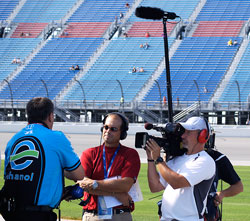 While I was out shooting Team Ethanol Driver Ryan Hunter-Reay during the first practice run I got into a friendly competition for the best shots with the production crew working with John Basset. John clued me into to exciting news that Ryan Hunter-Reay is being featured on RushHD TV, a television channel that focuses on sports around the world and broadcasts in high-def. John says the hour-long feature will air later this fall.