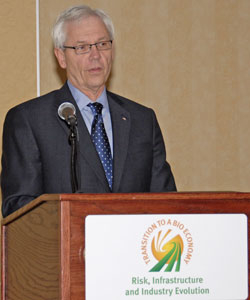
 The opening speaker for day two of Farm Foundation’s Transition To A Bio Economy conference is our USDA Under Secretary for Rural Development, Thomas Dorr. He talked about rural policy and we visited for a while before the session got started.
He says that rural policy is more important and timely a topic now than it has ever been, especially as we’re coming off the finalization of the 2008 Farm Bill. Some reasons include the huge growth in the deployment of broadband internet access and the demand for food and energy. With growth in rural communities people are starting to think differently when it comes to policy issues like conservation.
He pointed out that 95 percent of all rural income is off farm and that there haven’t been any new jobs in agriculture in recent years. So he says we need to look at unique uses of local resources for development but that development creates demands on infrastructure like water and sewer. He says that by meeting goals of replacing oil with renewable energy sources we’re creating a significant rural investment opportunity. So the question he poses to communities is “Are they willing to step up?”
Dorr has a long history with the Farm Foundation since he was a member of the round table prior to his appointment in Washington, DC. He also talks about the Foundation’s rural development opportunity tours and one that’s planned for this summer in Europe where he’ll be participating in a farmer to farmer dialogue.
You can listen to my interview with Tom here: [audio:http://www.zimmcomm.biz/farm-foundation/ff-bio-08-dorr.mp3]
You can also download the interview using this link (mp3).
Transition To A Bio Economy Photo Album


 Due to the current market volatility, VeraSun Energy will delay the startup of its 110 million-gallon-per-year ethanol production facility in Hankinson, N.D. This is the third VeraSun facility that has delayed startup operations this month due to market conditions, the other two being Welcome, Minn., and Hartley, Iowa. Construction on the Hankinson facility will be completed by the end of June, while construction on the Hartley and Welcome biorefineries was completed earlier this month.
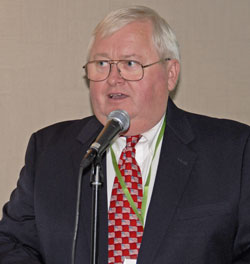 To wrap things up here at the Farm Foundation Transition To A Bio Economy conference I spoke with board member, Cornelius Gallagher. He says the conference brought together world class leaders who were able to listen to some fantastic presentations. I’ve posted interviews with almost all of them so please scroll back through them.
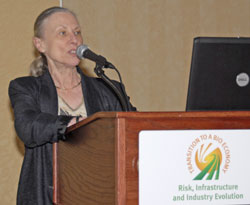 What we know and what we need to know was Peggy Caswell’s, USDA-ERS, topic here at the Farm Foundation Transition To A Bio Economy conference. She says we need to know things about how farmers or the providers of biofuels and feed stocks are going to have to change the way they do business. She used the example of having to look at different types of contracts and financing.
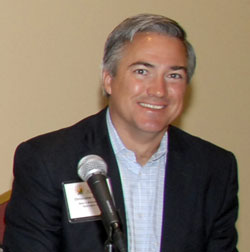 The issue of investment and financing for ethanol plants and bio refineries in general was addressed today by Chris Groobey, Baker & McKenzie, LLP. He works on project financing with investors and lenders and mostly in renewable fuels. He painted a pretty bleak picture.
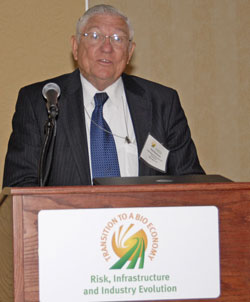 Our USDA Under Secretary for Research, Education and Economics is Gale Buchanan. He was here at the Transition To A Bio Economy conference to talk about the need for research in a growing bio economy. In fact, he sees a need for a tremendous amount of research to address the opportunities presented by the whole energy picture.
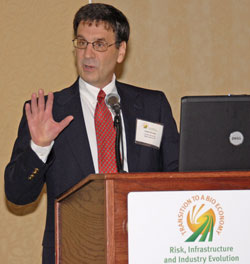 When it comes to infrastructure needs for a bio economy our rural road system is a key component. To speak about it here at the Transition To A Bio Economy conference we heard from Frank Dooley, Purdue University. He sees a big increase in grain production, primarily in the midwest. With that comes a growing demand for transportation. He thinks we should be concerned because most of the corn will be moved by truck and that’s going to impact rural roads. He also sees an increase in rail transportation but not significantly.
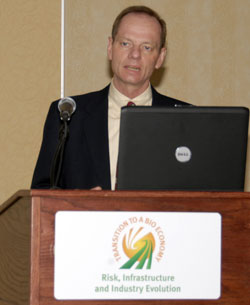 During our discussion on the infrastructure needs of a Transition To A Bio Economy, we heard from Paul Hammes, Union Pacific Railroad. Of course his focus was on rail infrastructure and as it relates to biofuels. Specifically, he spoke to the different pieces of that supply chain like rail cars, the rail network and unload/load capacity.
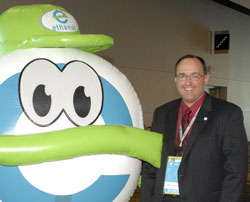 The
The